
Essential Maintenance Metrics Every Planner Needs to Know
Get Free Guide
Key Takeaways
- MRO spare parts inventory can account for 40–50% of your total maintenance budget. Optimizing it directly improves your bottom line.
- Annual carrying costs run 20–30% of total inventory value. Every dollar on the shelf costs you money in storage, obsolescence, and opportunity cost.
- Use ABC criticality analysis to focus your highest-control processes on the parts that matter most.
- A CMMS with inventory management features can automate reorder alerts, forecast demand from PM schedules, and identify problem suppliers.
- 15–25% of MRO inventory at many facilities is obsolete or surplus, so regular audits reclaim tied-up capital.
What is maintenance spare parts management?
Maintenance spare parts management is the systematic process of procuring, storing, tracking, and distributing replacement parts and consumable supplies needed to keep equipment operational. It encompasses inventory control, demand forecasting, supplier management, and integration with CMMS software to ensure the right parts are available when needed, without excessive carrying costs.
Example spare parts usage report from FastMaint CMMS showing spares & supplies consumed and received over the period along with costs
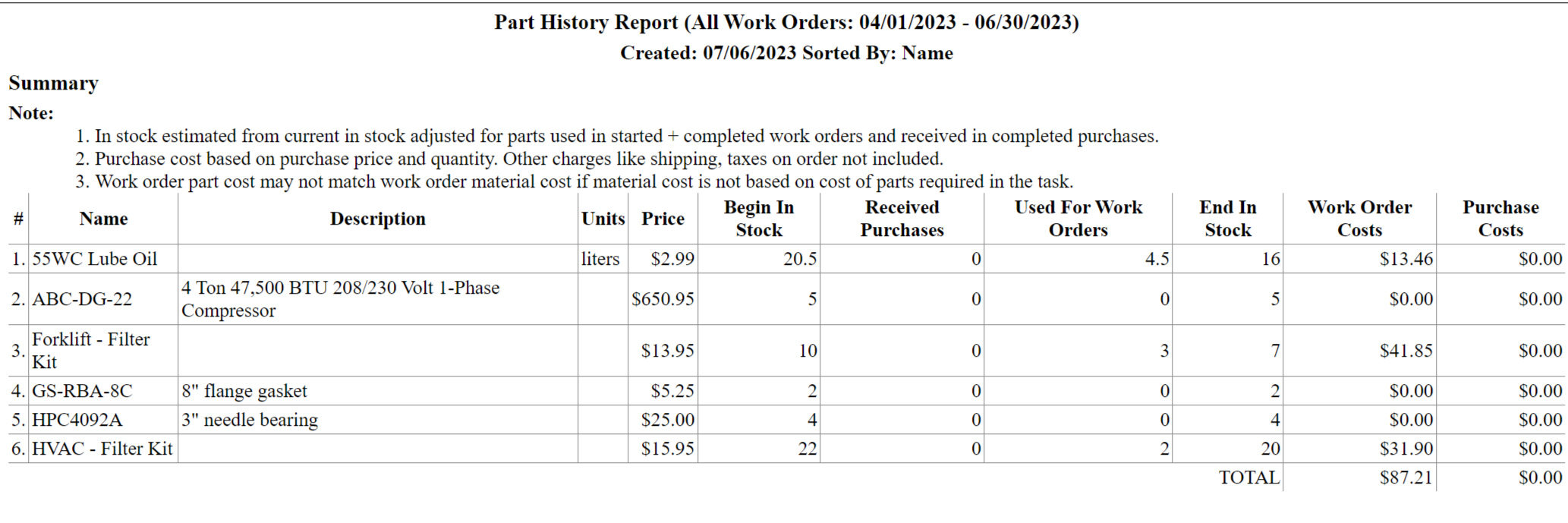
Table of Contents
- The Hidden Costs of Poor Spare Parts Management
- Classify Parts Using ABC Criticality Analysis
- Forecast Demand from Preventive Maintenance Schedules
- Set Data-Driven Reorder Points and Min/Max Levels
- Implement Just-in-Time (JIT) Inventory for Non-Critical Parts
- Evaluate and Select Reliable MRO Suppliers
- Standardize Parts and Maximize Interchangeability
- Conduct Regular Cycle Counts and Physical Audits
- Manage Obsolescence Through Equipment Lifecycle Tracking
- Organize Your Storeroom with 5S Principles
- Use CMMS Software to Tie It All Together
- Key Spare Parts Management KPIs to Track
- Frequently Asked Questions
The Hidden Costs of Poor Spare Parts Management
If you manage maintenance for a facility with hundreds or thousands of equipment types, you know the challenge: each asset has its own unique set of replacement components and consumables. Some of our FastMaint customers track several thousand different part types across their operations. Keeping all of this organized, properly stocked, and budget-friendly is one of the hardest problems in maintenance management.
The financial stakes are significant. In manufacturing environments, MRO (Maintenance, Repair, and Operations) inventory commonly accounts for 40–50% of the total maintenance budget. Industry experts estimate that annual carrying costs (including warehousing, insurance, degradation, and opportunity cost) run approximately 20–30% of total inventory value. That means a facility holding $500,000 in spare parts may be spending $100,000–$150,000 per year just to store and maintain that stock.
But the cost of not having parts is often worse. A missing $50 gasket can delay an equipment repair that costs hundreds of dollars per hour in lost production. When maintenance teams don’t have the right part at the right time, work orders get delayed, maintenance backlogs grow, and equipment reliability suffers.
The goal isn’t simply to stockpile everything. It’s to build a system where the right parts are available in the right quantities at the right time, without tying up excessive capital. Here are ten strategies to make that happen.
1. Classify Parts Using ABC Criticality Analysis
Not all spare parts deserve the same level of attention. ABC analysis, adapted from the Pareto principle, divides your inventory into three tiers based on value and consumption:
A-items are high-value parts that typically represent 10–20% of your total SKUs but account for 70–80% of inventory value. These require the tightest controls: frequent review cycles, accurate demand forecasting, and careful supplier management. Real-world data backs this up: an ABC classification study of over 4,200 spare parts at an oil and gas company found that just 7% of parts accounted for 74% of total inventory value.
B-items are moderate-value parts making up roughly 20–30% of SKUs and 15–25% of value. They need periodic review but not the day-to-day scrutiny of A-items.
C-items are low-cost, high-volume consumables (filters, gaskets, fasteners) that make up the majority of your SKUs but a small fraction of total value. These can often be managed with simpler reorder methods or vendor-managed inventory agreements.
Start by running an inventory value report from your CMMS software. Rank parts by annual consumption value (unit cost × annual usage), then assign categories. This single exercise often reveals that you’re applying the same level of control to a $5 filter and a $5,000 motor. That’s a common source of both wasted effort and inadequate protection.
2. Forecast Demand from Preventive Maintenance Schedules
One of the most reliable ways to predict future parts consumption is to look at your preventive maintenance schedules. Every scheduled PM task has a known bill of materials: the filters, belts, bearings, lubricants, and other items required to complete the job.
By projecting your PM schedule forward (say, 3–6 months), you can calculate exactly which parts you’ll need and when. This approach offers several advantages: you can negotiate volume discounts with suppliers by consolidating orders, you reduce emergency purchases, and you avoid overstocking items that won’t be needed for months.
CMMS software with planning reports makes this straightforward. In FastMaint, for example, you can run future period work order reports that list every part and quantity needed for upcoming scheduled maintenance. This transforms parts ordering from guesswork into a data-driven process.
3. Set Data-Driven Reorder Points and Min/Max Levels
Too many maintenance teams set inventory levels on gut feeling, ordering a replacement motor every six months because “that feels right.” This leads to both overstocking and stockouts, depending on how demand actually moves.
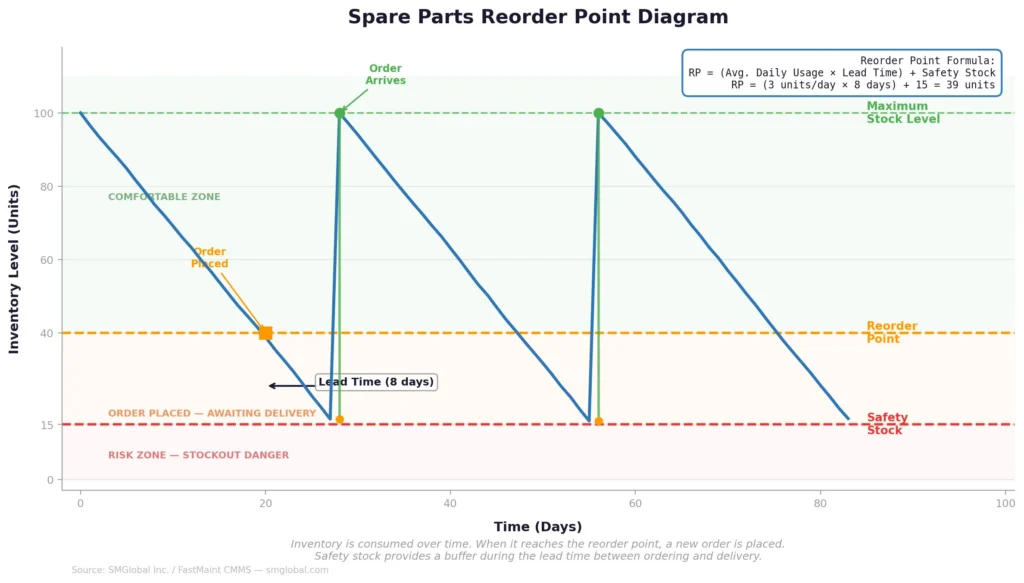
A more reliable method uses the reorder point formula:
Reorder Point = (Average Daily Usage × Lead Time in Days) + Safety Stock
Safety stock acts as a buffer against variability in both demand and supplier delivery times. For critical parts with long lead times, set higher safety stock levels. For C-items with short lead times and multiple available suppliers, safety stock can be minimal. See the “Spare Parts Reorder Point Diagram” below for a visual representation.
CMMS software automates this process. In FastMaint, you can set reorder levels for each part. When inventory drops below the threshold, the part gets flagged. In FastMaint’s case, it’s highlighted in red so you can see at a glance what’s running low. This is consistently one of our customers’ most-used features, because it removes the manual tracking burden while ensuring parts don’t run out unexpectedly.
Review and adjust your reorder points at least quarterly using actual consumption data from your CMMS reports, rather than relying on the values you set when the system was first configured.
4. Implement Just-in-Time (JIT) Inventory for Non-Critical Parts
Just-in-time inventory means ordering and receiving parts immediately before they’re needed for a maintenance job, rather than keeping them in stock indefinitely. This approach can significantly reduce carrying costs and free up warehouse space.
JIT works best for parts that meet specific criteria: they have short, reliable lead times from your suppliers; they are non-critical (meaning a brief delay won’t halt production); and they have predictable usage patterns tied to scheduled maintenance.
The risk with JIT is obvious: if a supplier misses a delivery, your maintenance job gets delayed. The cost of that delay (lost production, cascading equipment failures, extended downtime) almost always exceeds the cost of keeping a modest safety stock. This is why JIT should be applied selectively, primarily to non-critical items with dependable supply chains.
For critical spares (those A-items identified in your ABC analysis), the opposite approach is appropriate: maintain adequate safety stock regardless of carrying cost, because the consequences of a stockout are too severe.
5. Evaluate and Select Reliable MRO Suppliers
Poor-quality parts are a hidden multiplier of maintenance costs. A cheap bearing that fails after three months instead of twelve doesn’t save money. It creates unplanned downtime, a repeat work order, and double the labor cost. Use your maintenance records to identify which suppliers consistently provide parts that last and which ones are associated with premature failures.
When evaluating MRO suppliers, consider these criteria beyond just purchase price:
Part quality and failure rates: Review work order reports for repeat maintenance on the same equipment. Are technicians reporting parts-related problems in their feedback? Cross-reference failure patterns with supplier data to identify quality issues.
Lead time reliability: A supplier who promises 5-day delivery but regularly takes 10 days undermines your entire reorder point system. Track actual versus promised delivery times.
Supplier diversification: Don’t rely on a single source for critical parts. Having at least two qualified suppliers for your A-items protects against supply chain disruptions.
Corporate purchasing requirements may dictate some supplier choices, but if you have data showing that one vendor’s parts fail three times more often than another’s, that’s a compelling case to bring to the procurement department. Track sources of maintenance failure systematically to build this evidence.
6. Standardize Parts and Maximize Interchangeability
Part standardization means reducing the number of unique part types in your inventory by selecting common components that work across multiple equipment types. For example, if three different machines each use a different model of bearing with similar specifications, you may be able to standardize on one model that works for all three.
The benefits are significant: fewer unique SKUs to manage, higher order volumes for better pricing, reduced risk of stocking the wrong part, and simpler storeroom organization. Interchangeability, knowing which parts can substitute for each other, adds further flexibility. If Part A is out of stock but Part B is a verified substitute, your maintenance job doesn’t have to wait.
Work with your engineering and maintenance teams to identify standardization opportunities. Document part interchangeability in your CMMS so that when a technician looks up a part for a work order, they can also see approved alternatives.
7. Conduct Regular Cycle Counts and Physical Audits
Inventory records are only useful if they’re accurate. Discrepancies between your CMMS records and what’s actually on the shelf lead to false confidence (thinking you have a part when you don’t) or unnecessary purchases (buying what you already have).
Full physical inventory audits are valuable but disruptive. Cycle counting, where you count a small subset of parts on a rotating schedule, provides ongoing accuracy verification without shutting down the storeroom. A common approach is to count A-items monthly, B-items quarterly, and C-items annually.
When you find discrepancies, investigate the root cause. Common culprits include parts being taken from the storeroom without recording a withdrawal, receiving errors, and informal “borrowing” that bypasses transaction records. Fixing the process that caused the discrepancy is more important than simply correcting the count.
Your CMMS can support cycle counting by generating count schedules and tracking variance over time. If accuracy consistently falls below 95%, your storeroom processes need attention.
8. Manage Obsolescence Through Equipment Lifecycle Tracking
Every time a piece of equipment is retired or replaced, the spare parts associated with it may no longer be needed. Industry data suggests that 15–25% of MRO inventory at many facilities is obsolete or surplus. That’s a substantial amount of capital sitting on shelves doing nothing.
Proactive obsolescence management requires linking your parts inventory to your equipment records in your CMMS. When you identify equipment needing replacement, you can immediately flag the associated spare parts for review. Parts that are unique to the retired equipment can be returned to vendors, sold on surplus markets, or disposed of, freeing up both budget and warehouse space.
Set a quarterly review cycle to compare your active equipment list against your parts inventory. Look for parts with zero usage in the past 12–24 months and investigate whether they’re still needed. This discipline prevents the gradual accumulation of dead stock that quietly inflates your inventory costs year after year.
9. Organize Your Storeroom with 5S Principles
A disorganized storeroom causes a different kind of stockout: one where the part is physically present but nobody can find it. Mislocation is one of the leading causes of perceived stockouts, where maintenance teams order replacements for parts that were actually in the building all along.
The 5S methodology (Sort, Set in Order, Shine, Standardize, Sustain) provides a framework for storeroom organization:
Sort: Remove items that don’t belong, including obsolete parts, personal items, and non-inventory materials.
Set in Order: Assign every part a designated home location. Label shelves and bins with part numbers, descriptions, and min/max quantities. Record these locations in your CMMS.
Shine: Keep the storeroom clean and well-lit. Inspect parts for damage or degradation during routine cleaning.
Standardize: Create documented procedures for receiving, storing, issuing, and returning parts. Ensure every transaction is recorded in the CMMS.
Sustain: Make storeroom organization a permanent practice, not a one-time cleanup. Regular audits maintain the standard.
Remember that spare parts themselves need proper storage conditions. Rubber components degrade with UV exposure. Bearings can develop flat spots if stored improperly. Batteries lose charge over time. Follow manufacturer storage recommendations to ensure parts are functional when you finally need them.
10. Use CMMS Software to Tie It All Together
Every strategy above depends on accurate data: consumption history, equipment associations, supplier performance, reorder thresholds, and work order feedback. Trying to manage this with spreadsheets, paper records, or memory alone breaks down quickly as your operation grows. This is where CMMS (Computerized Maintenance Management System) software becomes essential.
Industry estimates suggest that organizations can save 5–10% on yearly spare parts inventory costs by implementing a structured maintenance management program supported by CMMS software. The savings come from multiple sources: reduced overstocking through better demand visibility, fewer emergency purchases through automated reorder alerts, lower obsolescence through equipment-to-parts linking, and better supplier decisions through quality tracking.
Here’s what to look for in CMMS inventory management features:
Parts usage and inventory reports: Track purchase and consumption history over time. These reports reveal spending trends and help right-size your maintenance budget for spares and supplies.
PM-based demand forecasting: Calculate parts and quantities needed for future preventive maintenance periods. This supports both volume purchasing discounts and JIT inventory strategies.
Automated reorder alerts: Get notified when any part drops below its reorder level. In FastMaint CMMS, parts below reorder level are highlighted in red for immediate visibility.
Equipment-to-parts association: Link parts to specific equipment so you can identify surplus inventory when assets are retired and quickly locate the right parts when work orders are created.
Work order feedback analysis: Review maintenance work order reports to spot recurring failures. Are technicians reporting parts-related problems? Cross-referencing this data with supplier information helps you audit your maintenance program and tag reliable versus underperforming vendors.
Key Spare Parts Management KPIs to Track
You can’t improve what you don’t measure. These are the most important metrics for evaluating and improving your spare parts management program:
Inventory Turnover Rate: How often your spare parts inventory is consumed and replenished over a given period. Low turnover may indicate overstocking or obsolete inventory.
Stockout Frequency: How often a needed part is unavailable when required for a work order. High stockout rates directly correlate with increased downtime and delayed maintenance.
Service Level (Fill Rate): The percentage of parts requests fulfilled from existing stock. A target of 95–97% is common for well-managed storerooms.
Carrying Cost as % of Inventory Value: Your annual cost to hold inventory, expressed as a percentage. Benchmark: 20–30% is typical. Anything higher signals opportunities for improvement.
Emergency Order Percentage: The proportion of parts purchases made on an emergency or rush basis. These orders typically cost significantly more and indicate gaps in demand forecasting.
Inventory Accuracy: The match rate between your CMMS records and actual physical counts. Target at least 95% accuracy to maintain reliable reorder systems.
Obsolete Inventory %: The proportion of your total inventory that is no longer needed. Best-in-class operations keep this below 5%.
Your CMMS should make it straightforward to track these metrics through standard reports. Review them monthly or quarterly and use the trends to guide your continuous improvement efforts. For more on maintenance metrics, request our free guide on Essential Maintenance Metrics Every Planner Needs to Know.
Ready to Optimize Your Spare Parts Management?
FastMaint CMMS includes inventory tracking, reorder alerts, equipment-to-parts linking, PM demand forecasting, and supplier quality reporting. That’s the toolkit you need to put the strategies in this guide to work.
Frequently Asked Questions About Spare Parts Management
What is maintenance spare parts management?
Maintenance spare parts management is the systematic process of procuring, storing, tracking, and distributing replacement parts and consumable supplies needed to maintain equipment. It encompasses inventory control, demand forecasting, supplier management, and integration with work order systems to ensure the right parts are available when needed, without excessive carrying costs.
What is ABC analysis in spare parts management?
ABC analysis classifies spare parts into three categories based on their value and consumption patterns. A-items are high-value parts that typically represent 10–20% of SKUs but 70–80% of inventory value. B-items are moderate-value parts making up about 20–30% of SKUs and 15–25% of value. C-items are low-cost, high-volume consumables that account for 50–70% of SKUs but only 5–10% of total value. Each category receives a different level of inventory control and review frequency.
How do you calculate reorder points for spare parts?
The basic formula is: Reorder Point = (Average Daily Usage × Lead Time in Days) + Safety Stock. Safety stock accounts for variability in both demand and supplier lead times. For critical spare parts with long lead times, set higher safety stock. CMMS software can automate this calculation using historical consumption data and vendor delivery performance.
How does a CMMS help with spare parts inventory?
A CMMS helps manage spare parts by tracking inventory levels in real time, associating parts with specific equipment, generating usage and consumption reports, automating reorder alerts when stock drops below set thresholds, forecasting future parts needs based on PM schedules, and identifying problem suppliers through work order feedback analysis. Learn more about FastMaint CMMS features.
What is the average carrying cost of maintenance spare parts?
Industry estimates place the annual carrying cost of spare parts inventory at roughly 20–30% of total inventory value. This includes warehousing, insurance, obsolescence, degradation, and opportunity cost. For example, if your facility holds $500,000 in spare parts, you may spend $100,000–$150,000 per year just to maintain that stock.
How do you reduce spare parts obsolescence?
Reduce obsolescence by regularly auditing inventory against your active equipment list, promptly flagging parts tied to retired assets, using your CMMS to track equipment lifecycle status, selling or returning unneeded parts, and setting quarterly review cycles to identify slow-moving stock. Industry data suggests 15–25% of MRO inventory at many facilities is obsolete or surplus.
What is the difference between critical and non-critical spare parts?
Critical spare parts are components whose absence would immediately halt production or create safety hazards. They typically have long lead times, few substitutes, and high failure consequences. Non-critical parts are those where a short delay won’t significantly impact operations. An asset criticality analysis (ACA) helps classify parts so you can allocate stocking budgets accordingly.
How does predictive maintenance affect spare parts inventory?
Predictive maintenance uses condition-monitoring data (vibration, temperature, oil analysis) to forecast when equipment will need service. This shifts parts demand from unpredictable to plannable, letting teams order parts just before they’re needed rather than stockpiling. Organizations using predictive approaches report significantly fewer emergency purchases and lower overall inventory costs.
What KPIs should I track for spare parts management?
Key KPIs include: inventory turnover rate, stockout frequency, service level (fill rate), carrying cost as a percentage of inventory value, emergency order percentage, average supplier lead time, inventory accuracy, and obsolete inventory percentage. Track these in your CMMS to identify improvement opportunities.
How much of a maintenance budget typically goes to spare parts?
MRO inventory commonly accounts for 40–50% of the total maintenance budget in manufacturing environments. The exact percentage varies by industry, equipment age, and maintenance strategy. Facilities that optimize spare parts management through CMMS software, criticality analysis, and demand forecasting can reduce this percentage while maintaining or improving equipment availability.
Related Reading
- 7 Tips to Plan Equipment Preventive Maintenance
- Easy Ways to Create an Equipment Maintenance Schedule
- How to Manage Maintenance Backlog for Equipment
- 7 Breakdown Maintenance Planning Tips
- Maintenance Management: Sources of Failure
- Using Maintenance Software to Identify Equipment Needing Replacement
- Six Signs Your Maintenance Plan Needs to Change
- Easy 5-Step Maintenance Management Program Audit
- Machine Maintenance: How to Keep Your Machinery Healthy
- FastMaint CMMS Case Studies
Note: Industry benchmarks cited in this article (carrying costs, MRO budget percentages, obsolescence rates) are drawn from widely published maintenance industry research and may vary by industry, facility size, and equipment profile. Consult organizations like SMRP (Society for Maintenance & Reliability Professionals) and review standards such as ISO 55001 for asset management frameworks applicable to your operation.
Essential Maintenance Metrics Every Planner Needs to Know
Get Free Guide